
GDPR has been around for a few years already, yet many fintechs are still treating it as a side project. A privacy notice on the website, a template data protection policy, a one-hour e-learning for staff, and it feels like the topic is covered.
It is not.
If you work in banking, payments, e-money, lending or crypto, GDPR cuts across your entire business model. Customer onboarding, KYC, risk scoring, fraud monitoring, marketing, data analytics, outsourcing, cloud, incident response. All of this runs on personal data. If you do not understand GDPR in this context, you are accepting legal, operational and reputational risk every single day.
Why GDPR matters so much in fintech
Fintechs are built on speed and data. That is exactly what makes GDPR both a constraint and an opportunity.
- You are processing highly sensitive data
Not just names and emails. You process transaction histories, behavioural patterns, device data, geolocation, sometimes biometric identifiers. This creates a rich profiling picture that regulators care about a lot. - You are under multiple regulatory regimes at once
GDPR does not live in isolation. You have AML/CTF rules, payment regulations, sanctions, sometimes MiCA, consumer protection law, NIS2, sector security expectations. These regimes often pull in different directions. You cannot comply with one and ignore the others. - You often rely on complex vendor and cloud chains
API-based business models depend on KYC providers, fraud engines, cloud platforms, open banking aggregators and analytics tools. Each link in that chain is a GDPR risk if you do not understand roles, responsibilities and transfer rules. - “We did not know” is not a defence
The accountability principle means you must not only comply, but be able to demonstrate how you comply. If your explanations to a regulator sound like generic theory, you will not pass a serious inspection.
The usual mistakes
Most fintechs repeat the same patterns:
- Using consent as a default lawful basis where it clearly does not fit.
- Over-collecting KYC data “just in case” without a clear purpose and retention logic.
- Mixing AML, fraud and marketing use of data without transparent separation.
- Outsourcing critical processes to vendors without real control or documentation.
- Treating DPIAs, RoPA and TIAs as paperwork exercises instead of real risk analysis.
These are not harmless details. They are the kind of weaknesses that regulators, data protection authorities and auditors look for first.
Why generic GDPR training is not enough
Most privacy trainings on the market are written for “any company”. E-shops, HR systems, basic CRM use. That level is fine if you only need staff awareness. It is not enough if you are:
- signing off on products, features or vendors,
- responsible for AML / risk / compliance,
- acting as DPO for a financial institution,
- sitting on a board or in senior management of a regulated entity.
You need sector specific answers. How GDPR works when there is a legal obligation to monitor transactions. How far legitimate interest goes in fraud prevention. Where the limits are for analytics and personalisation in financial products. How to justify real decisions in writing.
This is exactly the gap the GDPR for Fintech course at Legalogix Academy is designed to close.
What the GDPR for Fintech course covers
The course is built around real scenarios from banks, EMIs, payment institutions and crypto businesses. It focuses on how GDPR lives inside day to day operations, not just in policy documents.
Key themes include:
- Mapping personal data flows in onboarding, KYC, EDD, monitoring and support.
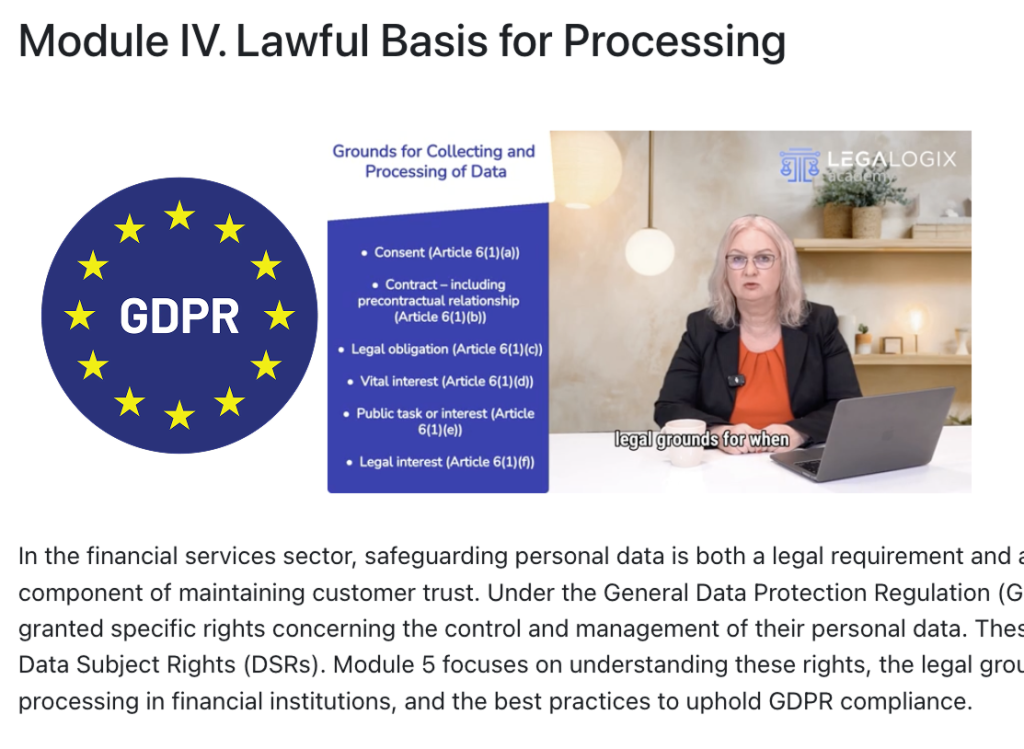
- Choosing a lawful basis that actually fits a financial use case, and writing it down in a way you can defend.
- Handling data subject rights where AML, tax and accounting rules do not allow simple deletion.
- Privacy by design in system architecture, testing, logging and analytics.
- Working with processors, sub processors, cross border transfers and cloud platforms.
- Designing and documenting DPIAs, TIAs and internal controls that are more than placeholders.
- Preparing for incidents and breaches so the first serious case does not destroy your credibility.
You see how GDPR, AML and operational risk interact, instead of treating them as separate worlds.
Who this course is for
This course is aimed at professionals whose decisions actually carry regulatory weight:
- Compliance, AML and risk officers, MLROs.
- Data Protection Officers working in or with financial institutions.
- Product owners, project managers and tech leads in fintechs and financial institutions.
- Board members and senior managers of banks, EMIs, PIs, lending and crypto companies.
If you can be the person answering questions from regulators, DPAs, auditors or investors, this course is relevant for you.
What you gain as a professional
By completing the course and applying what you learn, you will:
- Have a clear mental model of how GDPR works in a financial context, not just in theory.
- Be able to challenge weak setups and push back against unreasonable requests from inside the business.
- Understand how to design products and processes that balance growth and compliance instead of sacrificing one to the other.
- Strengthen your professional profile in a labour market that is short on people who understand both regulation and technology.
You can also prove it. The course ends with a knowledge check and certificate of completion, supported by training records your organisation can show to regulators and internal audit.
What your organisation gains
If your team takes GDPR seriously at a fintech level of complexity, your organisation benefits directly:
- Fewer obvious compliance gaps that create regulatory and reputational risk.
- Faster approvals for new products, features and partnerships because key people understand the rules.
- Stronger documentation for licensing, inspections and due diligence.
- A culture where privacy is treated as a part of risk management and governance, not an annoying afterthought.
Why Legalogix Academy
Legalogix Academy focuses on compliance training for financial institutions, fintechs and other obliged entities. Courses are created and delivered by practitioners who actively work in these areas, not just teach them.
The GDPR for Fintech course is part of a broader training portfolio that covers AML, sanctions, corporate governance and digital operational resilience, so your team can build a coherent view of regulatory risk instead of learning each topic in isolation.
If you are still relying on generic privacy webinars while handling EU customer data in a financial business, you are leaving too much to chance.
Join Legalogix Academy, enrol in the GDPR for Fintech course, and give your team training that matches the reality they actually work in.